Ephemeral Traces: Korean Duo's Robotic Bird Sculptures Challenge Human Impact and Memory
Introduction: The Ephemeral Footprint
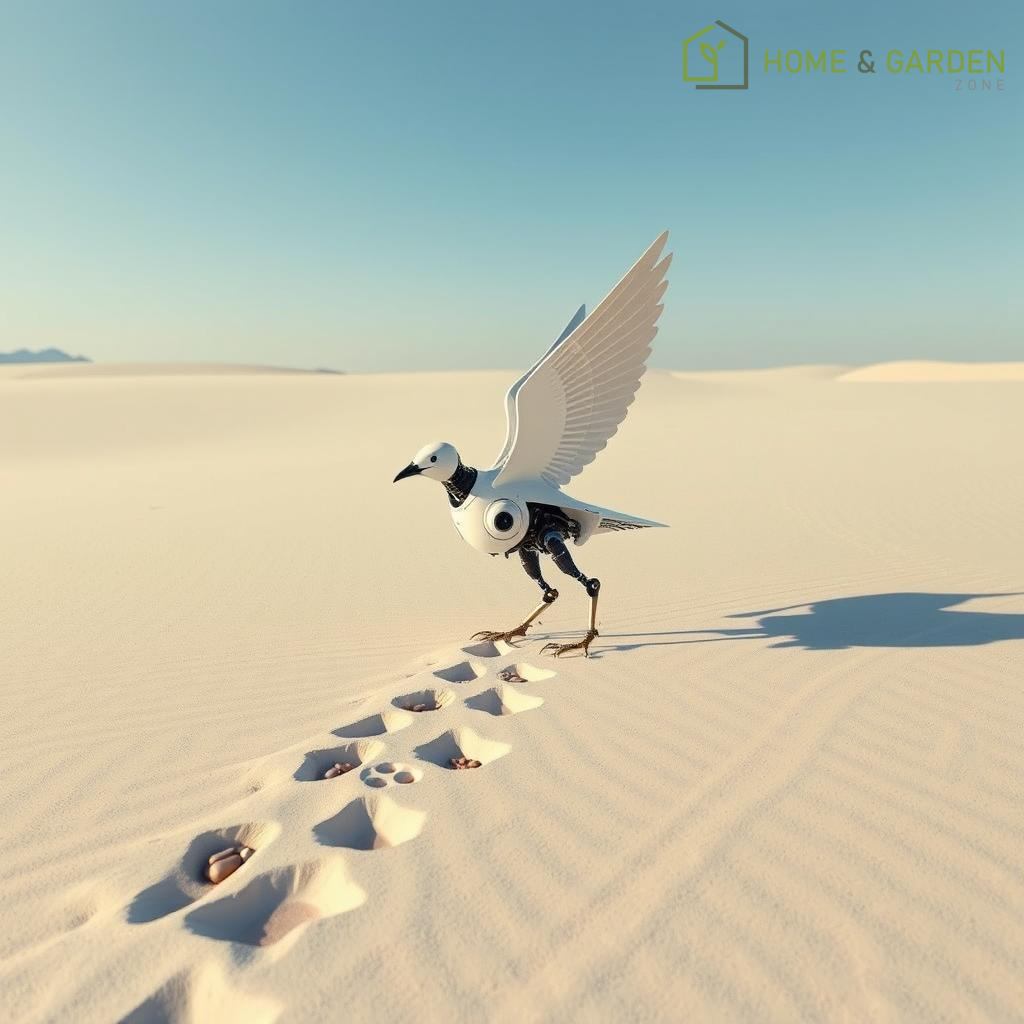
In a profound commentary on human presence and environmental impact, a Korean artist duo has unveiled a kinetic sculpture that confronts observers with the transient nature of existence and the deliberate act of erasure. This intricate work, featuring a robotic bird that meticulously removes its own tracks in a sandy diorama, serves as a powerful metaphor for society's often-unseen attempts to nullify its own effects.
The Installation: A Cyclical Narrative of Erasure
Situated within a meticulously crafted diorama concept, the installation presents a barren sand terrain—a stark canvas for the unfolding narrative. Central to this landscape are two distinct mechanical devices operating in a cyclical rhythm. The primary component is a robotic bird, designed with an uncanny resemblance to a natural avian form, which traverses the sandy expanse, leaving a trail of delicate footprints. Following closely, or in a synchronized movement, a second mechanism meticulously sweeps away these very imprints, ensuring no lasting mark remains. This continuous cycle of creation and obliteration underscores the core theme: the systematic removal of evidence, whether by natural processes or conscious human design.
Social Commentary: Confronting Our Impact
The duo's deliberate choice of a self-erasing mechanism transcends mere aesthetic play; it functions as incisive social commentary. The act of a creature erasing its own traces can be interpreted in multiple dimensions:
- Environmental Responsibility: It prompts contemplation on humanity's ecological footprint and the desire, or necessity, to erase the adverse marks left on the planet.
- Historical Revisionism: The cyclical erasure mirrors attempts to rewrite or conveniently forget past societal actions, conflicts, or injustices.
- Digital Anonymity: In an age of pervasive digital surveillance, the artwork touches upon the longing for anonymity and the impossible quest to truly "delete" one's digital presence.
- The Nature of Memory: It explores how memories, both personal and collective, can fade, be distorted, or actively suppressed over time.
The stark beauty of the piece lies in its quiet but persistent action, forcing viewers to confront uncomfortable truths about permanence, responsibility, and the often-futile endeavor of total effacement.
Artists' Vision: Anonymous Critique
While the specific names of the Korean artist duo are often held close to the core concept, their artistic intent is clear: to provoke thought without dictating a singular conclusion. Their work encourages introspection into the cycles of creation and destruction inherent in both nature and human society. The absence of a definitive "mark" or lasting impact from the robotic bird contrasts sharply with the indelible and often destructive marks humanity leaves on the world, suggesting a utopian ideal of zero impact or a dystopian warning of willful ignorance.
Summary
The robotic bird installation by the Korean artist duo is a compelling piece of kinetic art that uses the simple, repetitive act of erasing footprints to spark complex reflections. It masterfully intertwines themes of environmentalism, historical memory, and societal accountability, offering a poignant critique of our collective and individual impacts on the world. Its cyclical nature ensures that the commentary remains perpetually relevant, prompting viewers to consider what traces they leave behind and what they choose to forget.
Resources
Details
Author




Latest articles



 }})
You can now watch HBO Max for $10
Introduction: The Ephemeral Footprint
In a profound commentary on human presence and environmental impact, a Korean artist duo has unveiled a kinetic sculpture that confronts observers with the transient nature of existence and the deliberate act of erasure. This intricate work, featuring a robotic bird that meticulously removes its own tracks in a sandy diorama, serves as a powerful metaphor for society's often-unseen attempts to nullify its own effects.
The Installation: A Cyclical Narrative of Erasure
Situated within a meticulously crafted diorama concept, the installation presents a barren sand terrain—a stark canvas for the unfolding narrative. Central to this landscape are two distinct mechanical devices operating in a cyclical rhythm. The primary component is a robotic bird, designed with an uncanny resemblance to a natural avian form, which traverses the sandy expanse, leaving a trail of delicate footprints. Following closely, or in a synchronized movement, a second mechanism meticulously sweeps away these very imprints, ensuring no lasting mark remains. This continuous cycle of creation and obliteration underscores the core theme: the systematic removal of evidence, whether by natural processes or conscious human design.
Social Commentary: Confronting Our Impact
The duo's deliberate choice of a self-erasing mechanism transcends mere aesthetic play; it functions as incisive social commentary. The act of a creature erasing its own traces can be interpreted in multiple dimensions:
- Environmental Responsibility: It prompts contemplation on humanity's ecological footprint and the desire, or necessity, to erase the adverse marks left on the planet.
- Historical Revisionism: The cyclical erasure mirrors attempts to rewrite or conveniently forget past societal actions, conflicts, or injustices.
- Digital Anonymity: In an age of pervasive digital surveillance, the artwork touches upon the longing for anonymity and the impossible quest to truly "delete" one's digital presence.
- The Nature of Memory: It explores how memories, both personal and collective, can fade, be distorted, or actively suppressed over time.
The stark beauty of the piece lies in its quiet but persistent action, forcing viewers to confront uncomfortable truths about permanence, responsibility, and the often-futile endeavor of total effacement.
Artists' Vision: Anonymous Critique
While the specific names of the Korean artist duo are often held close to the core concept, their artistic intent is clear: to provoke thought without dictating a singular conclusion. Their work encourages introspection into the cycles of creation and destruction inherent in both nature and human society. The absence of a definitive "mark" or lasting impact from the robotic bird contrasts sharply with the indelible and often destructive marks humanity leaves on the world, suggesting a utopian ideal of zero impact or a dystopian warning of willful ignorance.
Summary
The robotic bird installation by the Korean artist duo is a compelling piece of kinetic art that uses the simple, repetitive act of erasing footprints to spark complex reflections. It masterfully intertwines themes of environmentalism, historical memory, and societal accountability, offering a poignant critique of our collective and individual impacts on the world. Its cyclical nature ensures that the commentary remains perpetually relevant, prompting viewers to consider what traces they leave behind and what they choose to forget.
Resources
Latest articles
You can now watch HBO Max for $10
Similar posts


This is a page that only logged-in people can visit. Don't you feel special? Try clicking on a button below to do some things you can't do when you're logged out.
Example modal
At your leisure, please peruse this excerpt from a whale of a tale.
Chapter 1: Loomings.
Call me Ishmael. Some years ago—never mind how long precisely—having little or no money in my purse, and nothing particular to interest me on shore, I thought I would sail about a little and see the watery part of the world. It is a way I have of driving off the spleen and regulating the circulation. Whenever I find myself growing grim about the mouth; whenever it is a damp, drizzly November in my soul; whenever I find myself involuntarily pausing before coffin warehouses, and bringing up the rear of every funeral I meet; and especially whenever my hypos get such an upper hand of me, that it requires a strong moral principle to prevent me from deliberately stepping into the street, and methodically knocking people's hats off—then, I account it high time to get to sea as soon as I can. This is my substitute for pistol and ball. With a philosophical flourish Cato throws himself upon his sword; I quietly take to the ship. There is nothing surprising in this. If they but knew it, almost all men in their degree, some time or other, cherish very nearly the same feelings towards the ocean with me.
Comment