Innovative Forest Pavilion in Japan Harmonizes Nature and Sustainable Design with Cedar, Cypress, and Reclaimed CLT
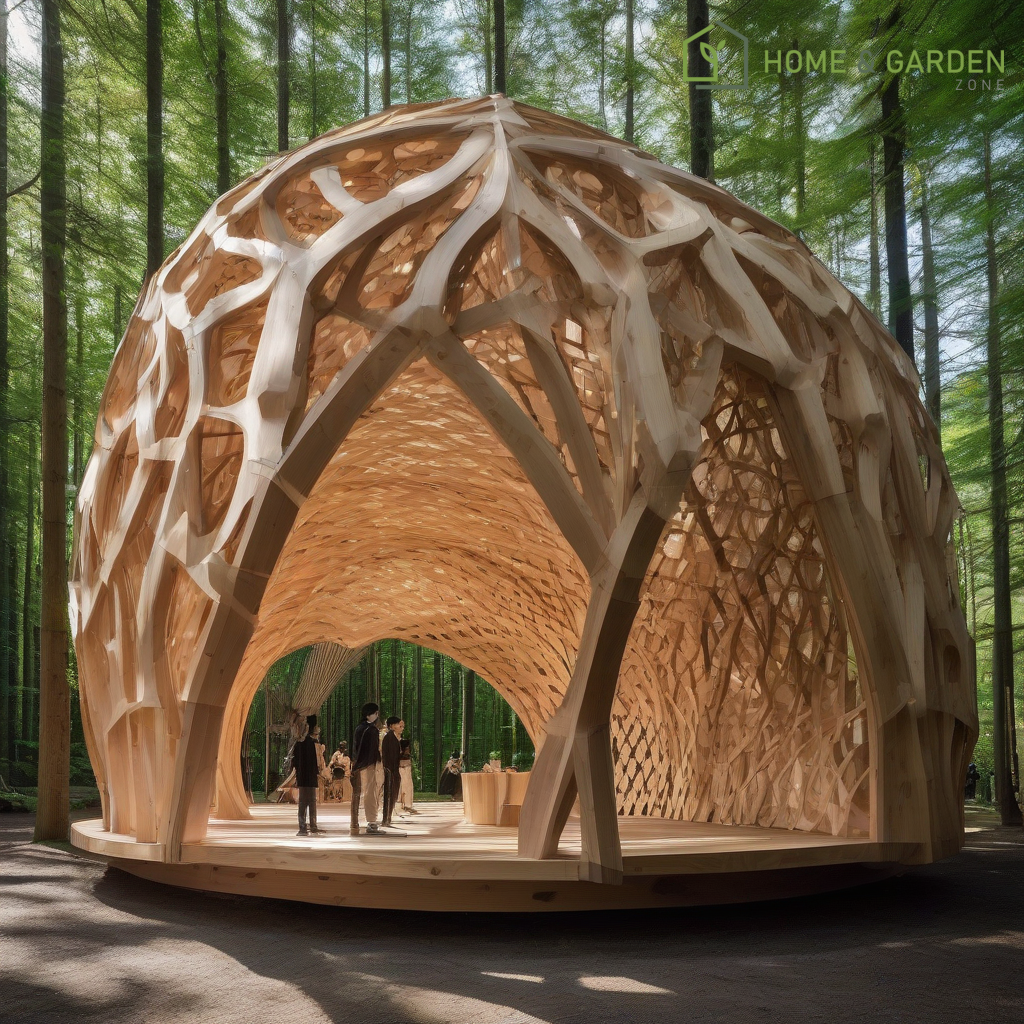
A Symphony of Sustainable Timber at Japan's Forest Festival
The annual Japan Forest Festival recently unveiled a temporary pavilion that masterfully integrates traditional Japanese timber with cutting-edge sustainable practices. This architectural installation, designed to engage visitors with the country's rich forestry heritage, stands as a testament to environmentally conscious construction and innovative design. Employing a unique blend of cedar, cypress, and reclaimed Cross-Laminated Timber (CLT), the pavilion not only minimizes its ecological footprint but also creates a compelling visual and tactile experience.
Central to the pavilion's striking aesthetic is its dynamic structural concept: three asymmetrical planes that gracefully rotate around an imaginary central axis. This innovative arrangement imbues the structure with a sense of movement and fluidity, allowing light and shadow to play across its surfaces throughout the day. The rotating planes also create varied spatial experiences within and around the pavilion, inviting exploration and contemplation of the surrounding natural landscape.
Materiality and Craftsmanship: A Blend of Tradition and Innovation
The selection of materials underscores a deep commitment to sustainability and local resources. Japanese cedar (sugi) and cypress (hinoki), prized for their beauty, durability, and aromatic qualities, form the primary structural and cladding elements. These timbers, sourced responsibly, highlight the importance of native species in sustainable building. Complementing these traditional materials is reclaimed Cross-Laminated Timber (CLT), a high-performance engineered wood product. The incorporation of reclaimed CLT not only diverts waste from landfills but also demonstrates the potential for circular economy principles in contemporary architecture. This thoughtful material palette speaks to both the historical reverence for wood in Japanese culture and the urgent need for resource efficiency in modern construction.
The construction methodology emphasizes precision and craftsmanship. The careful joinery and assembly of the timber elements showcase a blend of traditional Japanese woodworking techniques with modern fabrication methods. This attention to detail ensures not only the structural integrity and longevity of the temporary installation but also contributes to its refined aesthetic quality. The pavilion serves as an educational tool, illustrating how advanced timber construction can deliver both structural robustness and artistic expression.
Cultural Context and Environmental Impact
Situated within the context of Japan's Forest Festival, the pavilion extends beyond mere architectural display. It acts as a focal point for discussions on forest management, biodiversity, and the role of wood in a sustainable future. By creating an immersive environment built from the very resources it celebrates, the pavilion fosters a deeper connection between visitors and the natural world. Its temporary nature further highlights principles of adaptability and minimal intervention, demonstrating that impactful architecture need not be permanent to leave a lasting impression.
Conclusion
The temporary pavilion at Japan's Forest Festival represents a significant achievement in sustainable architectural design. By skillfully combining local cedar and cypress with reclaimed CLT, and by employing an imaginative structural concept of rotating asymmetrical planes, the project offers a compelling vision for future construction. It stands as a powerful symbol of how thoughtful design, material innovation, and respect for nature can converge to create spaces that are both beautiful and responsible.
Resources
- designboom | architecture & design magazine
- Japan Wood Products Information Center
- Forestry and Forest Products Research Institute (FFPRI), Japan
Details
Author




Latest articles





 }})
You can now watch HBO Max for $10
A Symphony of Sustainable Timber at Japan's Forest Festival
The annual Japan Forest Festival recently unveiled a temporary pavilion that masterfully integrates traditional Japanese timber with cutting-edge sustainable practices. This architectural installation, designed to engage visitors with the country's rich forestry heritage, stands as a testament to environmentally conscious construction and innovative design. Employing a unique blend of cedar, cypress, and reclaimed Cross-Laminated Timber (CLT), the pavilion not only minimizes its ecological footprint but also creates a compelling visual and tactile experience.
Central to the pavilion's striking aesthetic is its dynamic structural concept: three asymmetrical planes that gracefully rotate around an imaginary central axis. This innovative arrangement imbues the structure with a sense of movement and fluidity, allowing light and shadow to play across its surfaces throughout the day. The rotating planes also create varied spatial experiences within and around the pavilion, inviting exploration and contemplation of the surrounding natural landscape.
Materiality and Craftsmanship: A Blend of Tradition and Innovation
The selection of materials underscores a deep commitment to sustainability and local resources. Japanese cedar (sugi) and cypress (hinoki), prized for their beauty, durability, and aromatic qualities, form the primary structural and cladding elements. These timbers, sourced responsibly, highlight the importance of native species in sustainable building. Complementing these traditional materials is reclaimed Cross-Laminated Timber (CLT), a high-performance engineered wood product. The incorporation of reclaimed CLT not only diverts waste from landfills but also demonstrates the potential for circular economy principles in contemporary architecture. This thoughtful material palette speaks to both the historical reverence for wood in Japanese culture and the urgent need for resource efficiency in modern construction.
The construction methodology emphasizes precision and craftsmanship. The careful joinery and assembly of the timber elements showcase a blend of traditional Japanese woodworking techniques with modern fabrication methods. This attention to detail ensures not only the structural integrity and longevity of the temporary installation but also contributes to its refined aesthetic quality. The pavilion serves as an educational tool, illustrating how advanced timber construction can deliver both structural robustness and artistic expression.
Cultural Context and Environmental Impact
Situated within the context of Japan's Forest Festival, the pavilion extends beyond mere architectural display. It acts as a focal point for discussions on forest management, biodiversity, and the role of wood in a sustainable future. By creating an immersive environment built from the very resources it celebrates, the pavilion fosters a deeper connection between visitors and the natural world. Its temporary nature further highlights principles of adaptability and minimal intervention, demonstrating that impactful architecture need not be permanent to leave a lasting impression.
Conclusion
The temporary pavilion at Japan's Forest Festival represents a significant achievement in sustainable architectural design. By skillfully combining local cedar and cypress with reclaimed CLT, and by employing an imaginative structural concept of rotating asymmetrical planes, the project offers a compelling vision for future construction. It stands as a powerful symbol of how thoughtful design, material innovation, and respect for nature can converge to create spaces that are both beautiful and responsible.
Resources
- designboom | architecture & design magazine
- Japan Wood Products Information Center
- Forestry and Forest Products Research Institute (FFPRI), Japan
Latest articles
You can now watch HBO Max for $10
Similar posts


This is a page that only logged-in people can visit. Don't you feel special? Try clicking on a button below to do some things you can't do when you're logged out.
Example modal
At your leisure, please peruse this excerpt from a whale of a tale.
Chapter 1: Loomings.
Call me Ishmael. Some years ago—never mind how long precisely—having little or no money in my purse, and nothing particular to interest me on shore, I thought I would sail about a little and see the watery part of the world. It is a way I have of driving off the spleen and regulating the circulation. Whenever I find myself growing grim about the mouth; whenever it is a damp, drizzly November in my soul; whenever I find myself involuntarily pausing before coffin warehouses, and bringing up the rear of every funeral I meet; and especially whenever my hypos get such an upper hand of me, that it requires a strong moral principle to prevent me from deliberately stepping into the street, and methodically knocking people's hats off—then, I account it high time to get to sea as soon as I can. This is my substitute for pistol and ball. With a philosophical flourish Cato throws himself upon his sword; I quietly take to the ship. There is nothing surprising in this. If they but knew it, almost all men in their degree, some time or other, cherish very nearly the same feelings towards the ocean with me.
Comment