Shenzhen’s Terraced Learning Landscapes: Fostering Creativity and Exploration in Modern Education
Innovative Design for Contemporary Pedagogy
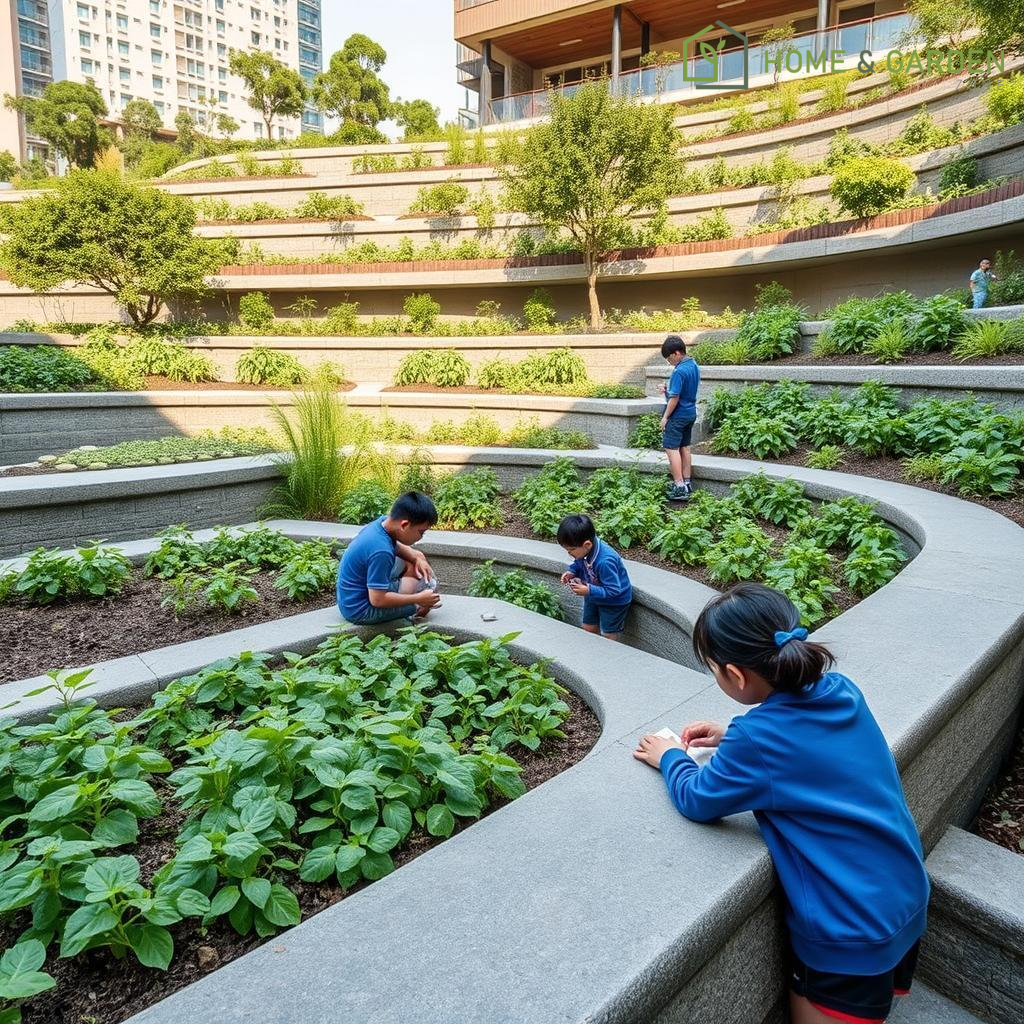
In the evolving landscape of global education, institutions are increasingly embracing architectural designs that actively support and enhance modern pedagogical models. A prime example emerges from Shenzhen, China, where a forward-thinking elementary school has integrated terraced landscapes as a cornerstone of its educational philosophy. This design paradigm moves beyond traditional classroom configurations, creating dynamic outdoor learning environments that champion creativity, exploration, and direct engagement.
The Architecture of Discovery
The school's design deftly incorporates multi-level terraced areas, transforming what might otherwise be utilitarian outdoor spaces into rich educational topography. These terraces are not merely aesthetic features; they are meticulously planned zones for active learning. They provide varied elevations and segregated areas that facilitate diverse activities, from ecological studies and gardening projects to outdoor theatrical performances and collaborative group work. This integration blurs the lines between indoor and outdoor education, promoting a seamless flow of learning that adapts to different subjects and student needs.
Anchoring Hands-On Learning and Exploration
Central to the school's mission is the belief that contemporary education thrives on experiential learning. The terraced landscapes are instrumental in achieving this. Children are encouraged to interact directly with their environment, observing natural processes, conducting simple experiments, and engaging in constructive play that hones problem-solving skills. These spaces become living laboratories where theoretical concepts taught in classrooms can be practically applied and understood. For instance, lessons on botany might involve planting and tending to a garden on one of the terraces, while physics concepts could be explored through experiments on inclines and declines.
Cultivating Creativity and Holistic Development
Beyond academic pursuits, the design fosters creativity and holistic development. The varied textures, natural elements, and open-ended nature of the terraced environments stimulate imaginative play and innovative thinking. Students are given the freedom to discover, adapt, and create their own learning experiences, moving away from rote memorization towards a deeper, more personal understanding. This approach cultivates resilience, curiosity, and a sense of stewardship towards the natural world, preparing students not just academically, but as well-rounded individuals capable of critical thought and empathetic engagement.
Summary
The Shenzhen elementary school's adoption of terraced landscapes represents a significant stride in educational infrastructure, aligning physical space with progressive pedagogical goals. By providing an environment rich in opportunities for hands-on learning, exploration, and creative expression, the school exemplifies how thoughtful design can profoundly influence and elevate the educational experience, nurturing the next generation of innovators and thinkers.
Resources
- Designboom | Architecture & Design Magazine
- ArchDaily
- World Architecture Festival (WAF)
Details
Author

Latest articles



 }})
You can now watch HBO Max for $10
Innovative Design for Contemporary Pedagogy
In the evolving landscape of global education, institutions are increasingly embracing architectural designs that actively support and enhance modern pedagogical models. A prime example emerges from Shenzhen, China, where a forward-thinking elementary school has integrated terraced landscapes as a cornerstone of its educational philosophy. This design paradigm moves beyond traditional classroom configurations, creating dynamic outdoor learning environments that champion creativity, exploration, and direct engagement.
The Architecture of Discovery
The school's design deftly incorporates multi-level terraced areas, transforming what might otherwise be utilitarian outdoor spaces into rich educational topography. These terraces are not merely aesthetic features; they are meticulously planned zones for active learning. They provide varied elevations and segregated areas that facilitate diverse activities, from ecological studies and gardening projects to outdoor theatrical performances and collaborative group work. This integration blurs the lines between indoor and outdoor education, promoting a seamless flow of learning that adapts to different subjects and student needs.
Anchoring Hands-On Learning and Exploration
Central to the school's mission is the belief that contemporary education thrives on experiential learning. The terraced landscapes are instrumental in achieving this. Children are encouraged to interact directly with their environment, observing natural processes, conducting simple experiments, and engaging in constructive play that hones problem-solving skills. These spaces become living laboratories where theoretical concepts taught in classrooms can be practically applied and understood. For instance, lessons on botany might involve planting and tending to a garden on one of the terraces, while physics concepts could be explored through experiments on inclines and declines.
Cultivating Creativity and Holistic Development
Beyond academic pursuits, the design fosters creativity and holistic development. The varied textures, natural elements, and open-ended nature of the terraced environments stimulate imaginative play and innovative thinking. Students are given the freedom to discover, adapt, and create their own learning experiences, moving away from rote memorization towards a deeper, more personal understanding. This approach cultivates resilience, curiosity, and a sense of stewardship towards the natural world, preparing students not just academically, but as well-rounded individuals capable of critical thought and empathetic engagement.
Summary
The Shenzhen elementary school's adoption of terraced landscapes represents a significant stride in educational infrastructure, aligning physical space with progressive pedagogical goals. By providing an environment rich in opportunities for hands-on learning, exploration, and creative expression, the school exemplifies how thoughtful design can profoundly influence and elevate the educational experience, nurturing the next generation of innovators and thinkers.
Resources
- Designboom | Architecture & Design Magazine
- ArchDaily
- World Architecture Festival (WAF)
Latest articles
You can now watch HBO Max for $10
Similar posts

This is a page that only logged-in people can visit. Don't you feel special? Try clicking on a button below to do some things you can't do when you're logged out.
Example modal
At your leisure, please peruse this excerpt from a whale of a tale.
Chapter 1: Loomings.
Call me Ishmael. Some years ago—never mind how long precisely—having little or no money in my purse, and nothing particular to interest me on shore, I thought I would sail about a little and see the watery part of the world. It is a way I have of driving off the spleen and regulating the circulation. Whenever I find myself growing grim about the mouth; whenever it is a damp, drizzly November in my soul; whenever I find myself involuntarily pausing before coffin warehouses, and bringing up the rear of every funeral I meet; and especially whenever my hypos get such an upper hand of me, that it requires a strong moral principle to prevent me from deliberately stepping into the street, and methodically knocking people's hats off—then, I account it high time to get to sea as soon as I can. This is my substitute for pistol and ball. With a philosophical flourish Cato throws himself upon his sword; I quietly take to the ship. There is nothing surprising in this. If they but knew it, almost all men in their degree, some time or other, cherish very nearly the same feelings towards the ocean with me.
Comment