Cultivating Joy: The Enduring Appeal of the Felt Play Watering Can in Childhood Development
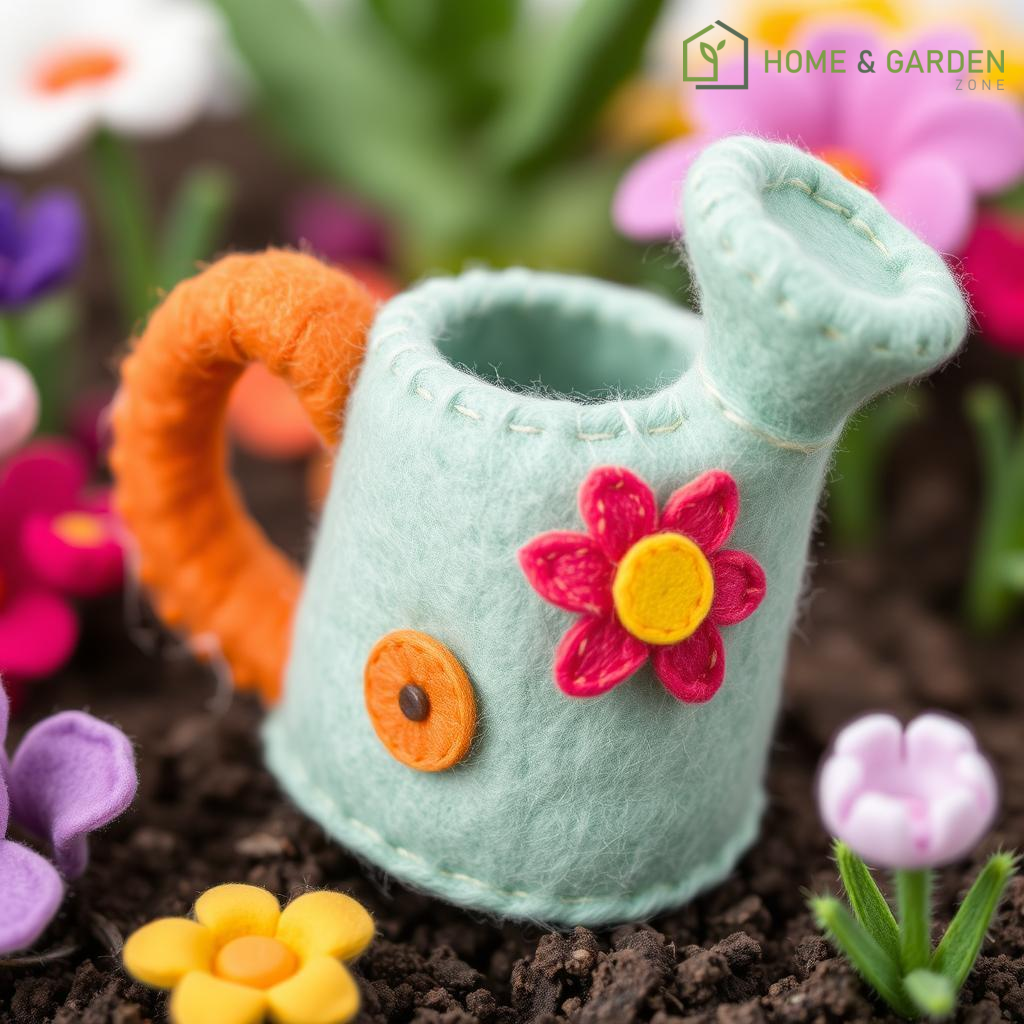
In an era where digital engagement often dominates childhood, the tactile simplicity of a felt play watering can emerges as a refreshing counterpoint. This unassuming craft item, celebrated for its blend of softness and structural integrity, offers more than just a toy; it provides a tangible gateway to imaginative play, fostering an early connection with nature and the foundational concepts of gardening.
The Genesis of Green Thumbs Through Play
The concept behind a felt play watering can is elegantly straightforward: to introduce the magic of gardening to young children in a safe, engaging, and developmentally appropriate manner. Unlike their functional counterparts, these felt versions are designed purely for imaginative exploration, allowing children to mimic adult gardening activities without the complexities of real tools or the need for actual water. This focus on pretend play is crucial for cognitive and social-emotional development, enabling children to experiment with roles, narratives, and problem-solving in a low-stakes environment.
The appeal lies in its dual functionality: soft enough for the gentlest hands, yet robust enough to maintain its form through countless hours of simulated watering, planting, and nurturing. This design philosophy ensures that the toy can withstand the rigors of enthusiastic play while remaining a comforting presence in a child's imaginative landscape.
Developmental Harvests from Pretend Gardening
Engaging with a felt play watering can contributes significantly to various aspects of child development:
- Imaginative & Creative Play: Children create their own gardening scenarios, inventing stories about what they are growing and caring for, which boosts creativity and narrative skills.
- Fine Motor Skills: Gripping the handle, tilting the "can," and mimicking watering actions help refine hand-eye coordination and strengthen small muscles.
- Cognitive Development: Understanding the sequence of gardening tasks, recognizing cause and effect (e.g., watering helps plants grow), and learning about plant care at a basic level.
- Emotional & Social Growth: Nurturing imaginary plants can instill a sense of responsibility and empathy. Playing with others fosters cooperation and sharing.
- Sensory Engagement: The soft texture of felt provides a gentle tactile experience, contrasting with the real-world elements it represents.
This type of play bridges the gap between abstract concepts and concrete experiences, laying a foundational appreciation for the natural world long before children engage with a real garden.
Summary
The felt play watering can represents a thoughtful approach to children's toys, prioritizing imaginative engagement and developmental benefits over complex features. It successfully translates the simple joy of gardening into a form accessible to the youngest aspiring horticulturists, proving that sometimes, the most effective tools for learning are those that inspire the most creative play. Its enduring charm lies in its capacity to encourage outdoor appreciation, foster responsibility, and cultivate a sense of wonder, all within the comforting embrace of a handcrafted item.
Resources
- Lia Griffith: https://liagriffith.com/felt-play-watering-can/
- National Association for the Education of Young Children (NAEYC): https://www.naeyc.org/our-work/families/5-essentials-imaginative-play
- Michigan State University Extension: https://www.canr.msu.edu/news/the_power_of_play_pretend_play_for_early_childhood
Details
Author




Latest articles





 }})
You can now watch HBO Max for $10
In an era where digital engagement often dominates childhood, the tactile simplicity of a felt play watering can emerges as a refreshing counterpoint. This unassuming craft item, celebrated for its blend of softness and structural integrity, offers more than just a toy; it provides a tangible gateway to imaginative play, fostering an early connection with nature and the foundational concepts of gardening.
The Genesis of Green Thumbs Through Play
The concept behind a felt play watering can is elegantly straightforward: to introduce the magic of gardening to young children in a safe, engaging, and developmentally appropriate manner. Unlike their functional counterparts, these felt versions are designed purely for imaginative exploration, allowing children to mimic adult gardening activities without the complexities of real tools or the need for actual water. This focus on pretend play is crucial for cognitive and social-emotional development, enabling children to experiment with roles, narratives, and problem-solving in a low-stakes environment.
The appeal lies in its dual functionality: soft enough for the gentlest hands, yet robust enough to maintain its form through countless hours of simulated watering, planting, and nurturing. This design philosophy ensures that the toy can withstand the rigors of enthusiastic play while remaining a comforting presence in a child's imaginative landscape.
Developmental Harvests from Pretend Gardening
Engaging with a felt play watering can contributes significantly to various aspects of child development:
- Imaginative & Creative Play: Children create their own gardening scenarios, inventing stories about what they are growing and caring for, which boosts creativity and narrative skills.
- Fine Motor Skills: Gripping the handle, tilting the "can," and mimicking watering actions help refine hand-eye coordination and strengthen small muscles.
- Cognitive Development: Understanding the sequence of gardening tasks, recognizing cause and effect (e.g., watering helps plants grow), and learning about plant care at a basic level.
- Emotional & Social Growth: Nurturing imaginary plants can instill a sense of responsibility and empathy. Playing with others fosters cooperation and sharing.
- Sensory Engagement: The soft texture of felt provides a gentle tactile experience, contrasting with the real-world elements it represents.
This type of play bridges the gap between abstract concepts and concrete experiences, laying a foundational appreciation for the natural world long before children engage with a real garden.
Summary
The felt play watering can represents a thoughtful approach to children's toys, prioritizing imaginative engagement and developmental benefits over complex features. It successfully translates the simple joy of gardening into a form accessible to the youngest aspiring horticulturists, proving that sometimes, the most effective tools for learning are those that inspire the most creative play. Its enduring charm lies in its capacity to encourage outdoor appreciation, foster responsibility, and cultivate a sense of wonder, all within the comforting embrace of a handcrafted item.
Resources
- Lia Griffith: https://liagriffith.com/felt-play-watering-can/
- National Association for the Education of Young Children (NAEYC): https://www.naeyc.org/our-work/families/5-essentials-imaginative-play
- Michigan State University Extension: https://www.canr.msu.edu/news/the_power_of_play_pretend_play_for_early_childhood
Latest articles
You can now watch HBO Max for $10
Similar posts




This is a page that only logged-in people can visit. Don't you feel special? Try clicking on a button below to do some things you can't do when you're logged out.
Example modal
At your leisure, please peruse this excerpt from a whale of a tale.
Chapter 1: Loomings.
Call me Ishmael. Some years ago—never mind how long precisely—having little or no money in my purse, and nothing particular to interest me on shore, I thought I would sail about a little and see the watery part of the world. It is a way I have of driving off the spleen and regulating the circulation. Whenever I find myself growing grim about the mouth; whenever it is a damp, drizzly November in my soul; whenever I find myself involuntarily pausing before coffin warehouses, and bringing up the rear of every funeral I meet; and especially whenever my hypos get such an upper hand of me, that it requires a strong moral principle to prevent me from deliberately stepping into the street, and methodically knocking people's hats off—then, I account it high time to get to sea as soon as I can. This is my substitute for pistol and ball. With a philosophical flourish Cato throws himself upon his sword; I quietly take to the ship. There is nothing surprising in this. If they but knew it, almost all men in their degree, some time or other, cherish very nearly the same feelings towards the ocean with me.
Comment